AI systems may reason. Zaubern decides what is allowed to happen.
Zaubern is Decision Execution Infrastructure for regulated AI. It does not just gate execution at runtime. It turns admissibility into deterministic authority artifacts, evidence-bound execution, and replayable proof for high-stakes workflows.
Execution authority
Zaubern governs execution, not just narration about execution.
Deterministic authority artifacts
High-stakes paths are evaluated through deterministic authority artifacts instead of raw model output alone.
Evidence-bound execution
Decisions stay tied to proof that security, legal, and regulators can inspect later.
Where AI authority becomes visible.
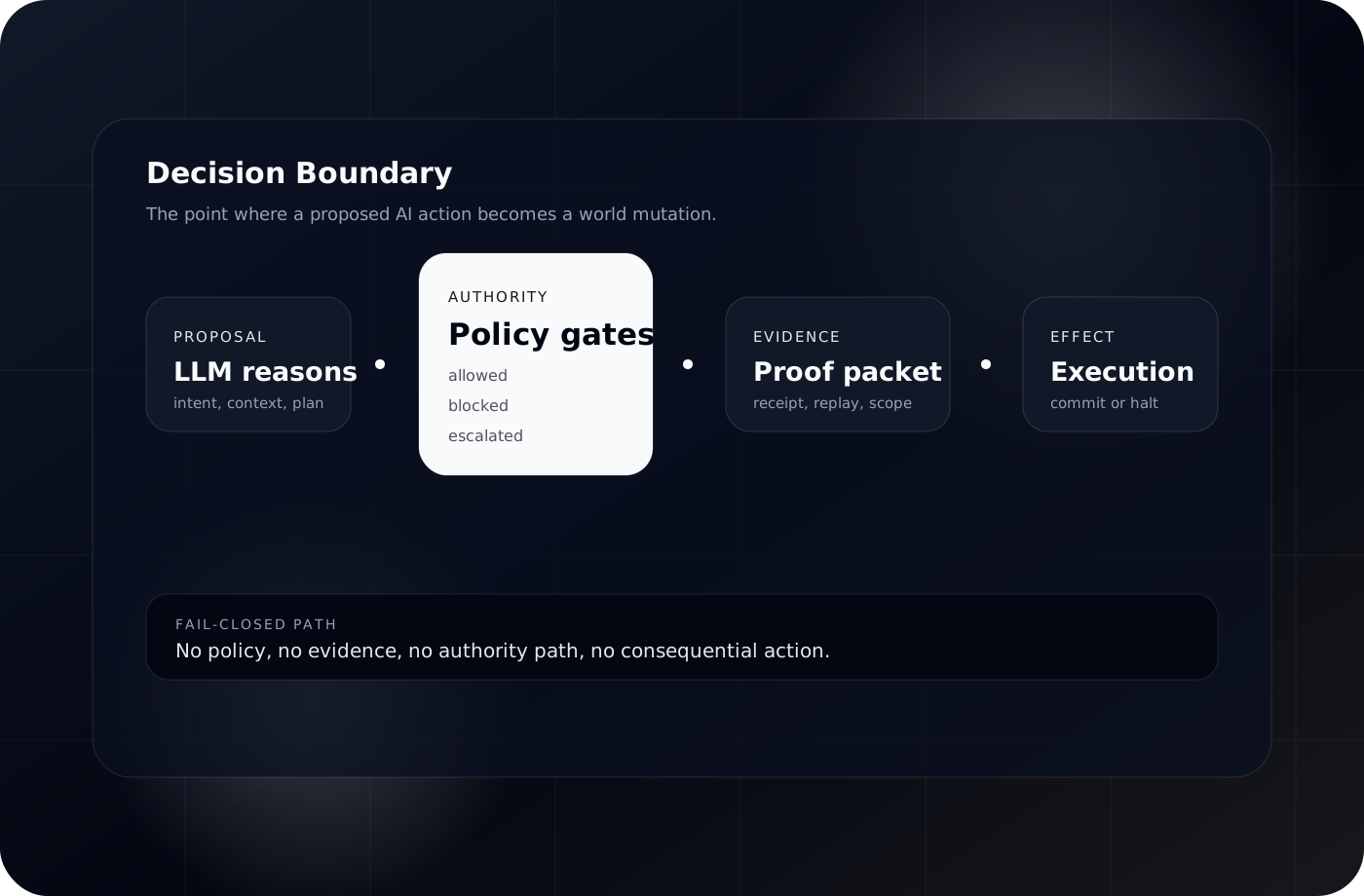
Zaubern separates model reasoning from operational authority. AI can propose an action, but policy gates, evidence requirements, and execution controls determine whether anything is allowed to change.

The three pages that define Zaubern
Understand the category, the mechanism, and the proof boundary before going deeper into the product narrative.
Category
What Is Decision Execution Infrastructure?
Start here if the main question is what Zaubern actually is and why it is not just another governance or observability tool.
Mechanism
How Zaubern Works
Read this if the category is clear and the next question is how reasoning, deterministic control, and replayable evidence fit together.
Proof
Proof and Assurance
Use this page when buyers, security, legal, or procurement need the narrow proof boundary instead of broad AI-assurance language.
Terminology
What SLM Means in Zaubern
In Zaubern, SLM means Symbolic Logic Model, not Small Language Model.
Most AI teams are securing the wrong layer
If you frame Zaubern as observability, memory, or generic governance software, you end up solving the wrong problem for the wrong buyer.
Post-hoc visibility
Observability
Shows what happened after the fact. Useful for investigation, but it does not decide whether an action should be allowed to execute.
Descriptive memory
Context graphs
Store and connect prior activity. They describe execution history, but they are not the authority layer that governs the next decision.
Hand-authored logic
Rule engines
Execute what humans explicitly encode. They are not designed to compile execution authority from AI behavior at runtime.
Decision Execution Infrastructure
Zaubern
Acts at the decision boundary. It determines what is admissible before a world effect occurs and keeps the governed path tied to evidence that can be replayed later.
Canonical distinction
Context graphs describe what happened. Symbolic Logic Models define what is allowed to happen.
The control model is simple
Zaubern separates probabilistic cognition from deterministic authority. That is what makes the category legible and the control surface defensible.
Probabilistic systems reason
Models and agents can propose actions, plans, and tool calls, but they do not receive direct execution authority.
Deterministic controls decide
A Symbolic Logic Model plus policy constraints evaluate whether the proposed action is allowed, blocked, or must be escalated.
Execution stays bounded
The runtime enforces the decision at the boundary where the mutation would occur. High-impact paths fail closed when controls are missing.
Evidence makes it replayable
Decision artifacts, provenance, and execution evidence are captured so security, legal, and regulators can independently review what happened.
What buyers need is evidence, not adjectives
Zaubern is built for teams that need a real execution boundary, not a more polished way to describe AI after it already acted.
Deterministic authority artifacts
Zaubern does not stop at a runtime check. It turns admissibility into deterministic authority artifacts that can be examined outside the originating model.
Evidence-bound execution
On governed paths, execution stays tied to evidence and provenance instead of relying on prompt obedience or reconstructed logs after the fact.
Replayable proof
Decision artifacts and evidence records turn approvals, blocks, and escalations into reviewable proof instead of vendor language.
Scoped pilot adoption
Start with one high-stakes workflow, prove the control boundary works, and expand only after the buyer, security, and legal teams are aligned.
Zaubern sells into authority owners
The buyer is usually the person who owns operational legitimacy, risk, or approval friction once AI crosses into real-world execution.
CIO and CISO
Need an authority layer for regulated AI without exposing code, data, or internal control posture.
COO, CRO, and risk owners
Need governed execution for workflows where a bad AI decision becomes an operational, financial, or safety event.
Legal and compliance
Need reviewable decision artifacts, not vague assurances that the model was instructed to behave.
Procurement and platform teams
Need proof the control layer can fit the current stack before they commit to a broader rollout.
Start with one high-stakes workflow.
The fastest path is not a broad transformation project. It is one workflow where decisions must be governed, replayable, and buyer-legible from day one.
What the first engagement should prove
- Wrap one real agent, automation, or decisioning path instead of a synthetic demo.
- Demonstrate allow, block, and escalate behavior at the actual decision boundary.
- Produce evidence artifacts the buyer, security team, and legal reviewers can inspect.
- Prove operational fit before anyone expands scope or invents unsupported compliance claims.
Talk with the team behind the decision boundary
Use WhatsApp or email for category briefings, technical reviews, and scoped pilot conversations.
Use WhatsApp for category briefings, pilot scoping, and quick review of a workflow that needs a governed decision boundary.
+1 404 624 6871
Send technical context, procurement questions, or pilot notes when the conversation needs more structure than chat.
Category clarity
We can help separate runtime authorization, observability, and policy process from the actual decision execution problem.
Pilot scoping
The best first conversation is usually one workflow where allow, block, escalate, and replay all matter.
Cross-functional review
Product, security, legal, and procurement can use the same conversation if the proof boundary needs to be clear early.