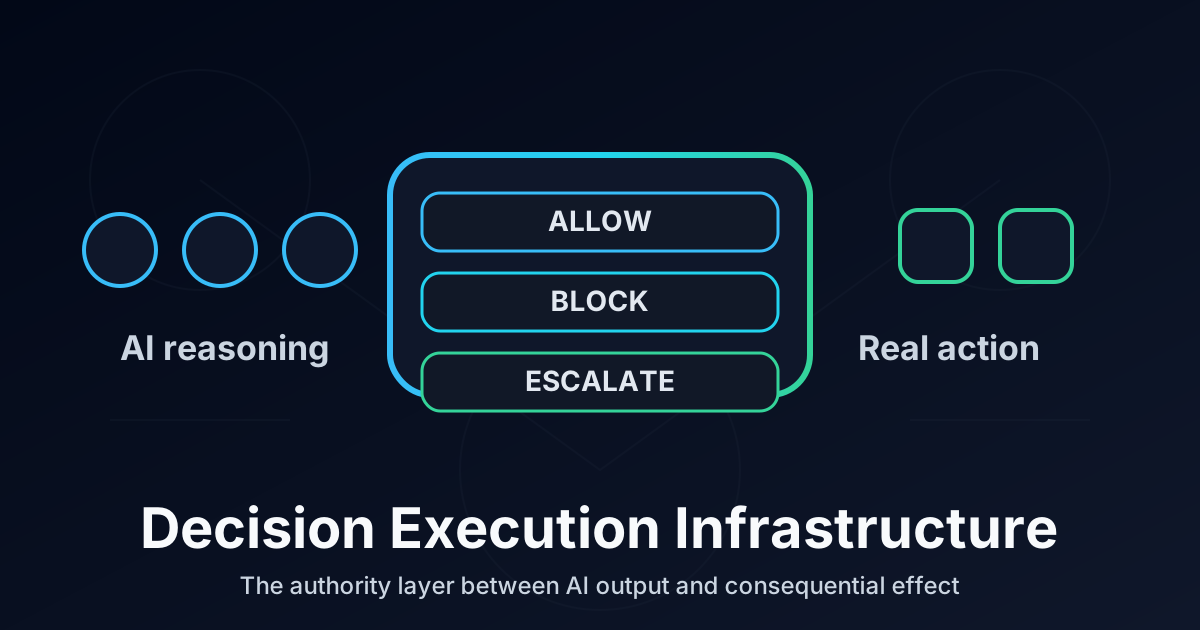
Most category mistakes look harmless at first. A company gets called AI governance, agent infrastructure, or agent observability, and everyone acts as if the difference is cosmetic. It is not. Once the category is wrong, the rest of the go-to-market process starts drifting.
What breaks when the category is off
- The wrong buyers step forward first.
- The wrong competitors get pulled into the conversation.
- The product gets judged against reporting, tracing, or memory problems instead of authority problems.
- The proof burden becomes fuzzy because nobody is sure what layer the product actually controls.
Why AI governance is too broad
Governance in the market usually means policy management, oversight workflows, reviews, templates, and documentation. Some of that matters. None of it answers the hardest operational question: when an AI-linked system is about to do something real, what exactly has the authority to decide whether that action is allowed?
What Decision Execution Infrastructure actually means
- A proposed action enters a deterministic control layer.
- The action is evaluated against explicit, versioned constraints.
- The system returns allow, block, or escalate.
- The decision emits evidence that can be replayed and inspected later.
Why this is a different product category
Observability tells you what happened after the fact. Context systems help an agent remember what happened before. Governance software helps institutions organize policy around the workflow. Decision Execution Infrastructure sits in the path where reasoning becomes effect.
"Probabilistic systems may reason, but deterministic systems must decide."
Why this category is showing up now
For years, many AI systems were advisory. They drafted, summarized, and recommended. Once agents start routing, sending, approving, mutating, or triggering downstream effects, the market needs more than model quality and after-the-fact visibility. It needs a credible authority layer.
Bottom line
Decision Execution Infrastructure is not a prettier label for AI governance. It names the missing layer between AI output and institutional action. If the market understands that layer clearly, Zaubern is easier to buy, easier to evaluate, and much harder to flatten into the wrong comparison set.
Related reading
Keep going with the pages that make the category, mechanism, and proof surface easier to understand.
What Is Decision Execution Infrastructure?
The pillar page version of the category argument, built for buyers, search, and internal linking.
Read nextHow Zaubern Works
Once the category is clear, this is the mechanism page that explains the authority boundary.
Read nextWhy AI Governance Is the Wrong Buying Frame
A direct follow-on for buyers still collapsing Zaubern into the governance bucket.
Read nextIf the article made sense, the next step is simple: get the category clear, then decide whether a pilot is worth discussing.
Zaubern is easiest to understand in two moves. First, define the layer: execution authority, not generic AI governance. Then review whether your workflow needs proof, replayability, and fail-closed control at the decision boundary.