One of the easiest ways to spot shaky AI go-to-market is to ask for proof. Not a demo. Not a page full of logos and architecture diagrams. Proof. What can the company actually show that survives contact with diligence?
What a proof packet is for
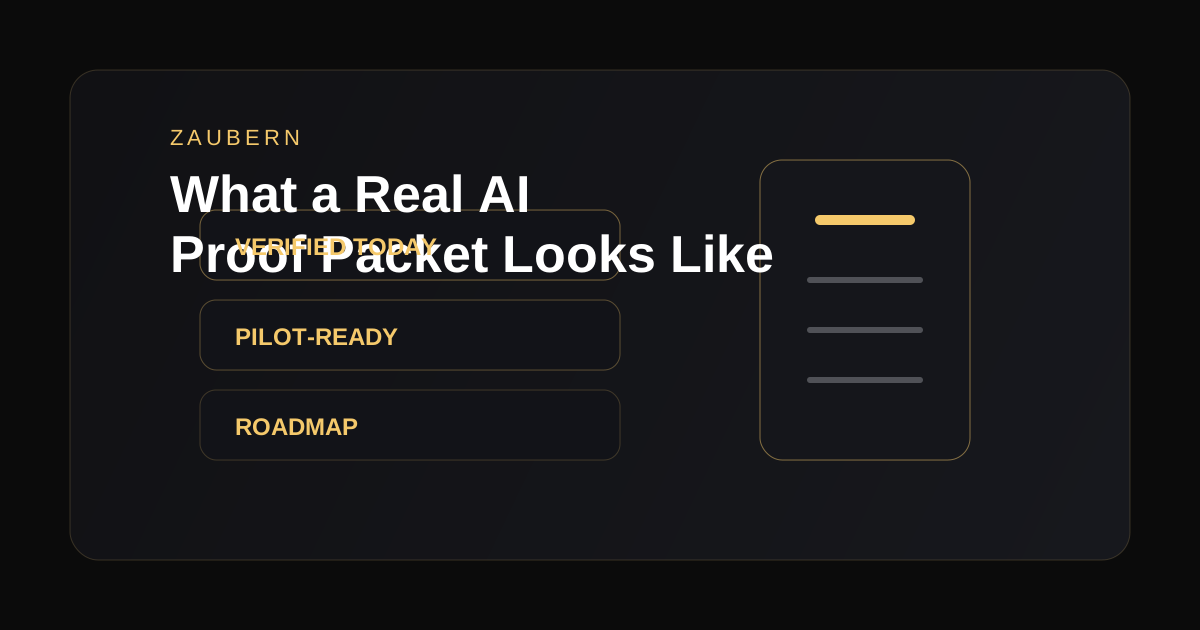
A real proof packet has one job: helping another party understand what is true today, what is only available in pilot, what remains roadmap, and what evidence supports each claim. Many vendors merge aspiration with capability, and that is exactly where the story starts to wobble.
Start with the scope table
- production-ready today
- available in pilot
- roadmap
- internal only
This is the part most teams skip because it feels unglamorous. Do it anyway. One table like this prevents half the confusion that usually infects vendor diligence.
Show the governed action path
- the proposed action
- the control evaluation point
- the decision outcome
- the emitted evidence
- the replay or verification path
Include the failure posture
Weak packets show the happy path and quietly assume that is enough. It is not enough. A serious buyer wants to know what happens when the evidence path breaks, when policy cannot be resolved, when the authority layer degrades, or when the system cannot classify the action safely.
What the packet should make explicit
- what class of product this is
- what action boundary it actually governs
- what is verified today
- what can be demonstrated in a pilot
- what evidence exists when a governed decision occurs
- what the company is not claiming
Bottom line
A proof packet is not there to make the company look impressive. It is there to make the truth easy to evaluate. In enterprise AI, that is usually much more valuable.
Related reading
Keep going with the pages that make the category, mechanism, and proof surface easier to understand.
Proof and Assurance for High-Stakes AI
The pillar page that sets the claim boundary before a buyer ever opens a proof packet.
Read nextThe Two-Day Agent Pilot
A proof packet is strongest when it pairs with a bounded pilot that shows allow, block, escalate, and fail closed.
Read nextProcurement Checklist for Agent Systems
The diligence questions procurement should ask once the packet is on the table.
Read nextIf the article made sense, the next step is simple: get the category clear, then decide whether a pilot is worth discussing.
Zaubern is easiest to understand in two moves. First, define the layer: execution authority, not generic AI governance. Then review whether your workflow needs proof, replayability, and fail-closed control at the decision boundary.