A lot of AI risk discussion stays too high up in the stack. Teams talk about prompts, hallucinations, red teaming, evaluations, and guardrails. Those things matter. They still do not tell you where institutional risk turns from theory into exposure.
The decision boundary
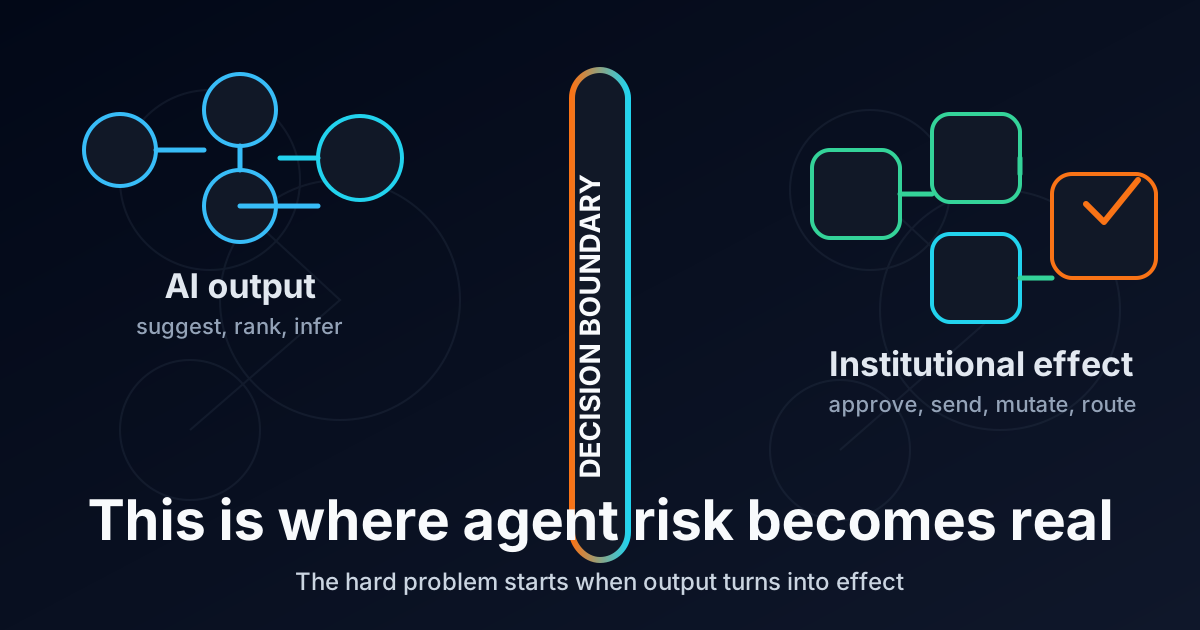
The decision boundary is the point where a system stops generating suggestions and becomes capable of producing a real effect. That effect might be a payment approval, a workflow transition, a data transfer, a release action, or a communication sent under company authority.
Why this boundary matters
- Before the boundary, the system is mostly participating in cognition.
- After the boundary, the institution is exposed to execution.
- That changes the proof burden, the control design, and the post-incident questions immediately.
The tools people confuse with boundary control
Prompt management shapes behavior before the boundary. Observability helps reconstruct behavior after the boundary. Governance process defines expectations around the boundary. None of those, by themselves, answer the operational question at the boundary itself.
- Given this proposed action, under this policy state, with this evidence, is the mutation allowed?
- If it is not allowed, is it blocked or escalated?
- If the control path degrades, does the action stop?
Why human-in-the-loop is not a complete answer
A human approval step can be a legitimate control. It can also be an expensive illusion. If the reviewer cannot actually evaluate the action, if the approval is rubber-stamped, or if the surrounding policy state is unclear, the institution still has a boundary problem.
Bottom line
The decision boundary is where agent risk becomes institutional. That is why the control design has to get serious there. Once output turns into effect, the organization needs something stronger than good prompts, useful traces, or a comforting dashboard.
Related reading
Keep going with the pages that make the category, mechanism, and proof surface easier to understand.
How Zaubern Works
The mechanism page that shows how Zaubern separates reasoning from authority at the boundary.
Read nextProof and Assurance for High-Stakes AI
Why the boundary question matters most when proof has to survive outside the vendor control plane.
Read nextWhat SLM Means and Why That Matters
A closer look at the deterministic artifact that matters at the decision boundary.
Read nextIf the article made sense, the next step is simple: get the category clear, then decide whether a pilot is worth discussing.
Zaubern is easiest to understand in two moves. First, define the layer: execution authority, not generic AI governance. Then review whether your workflow needs proof, replayability, and fail-closed control at the decision boundary.